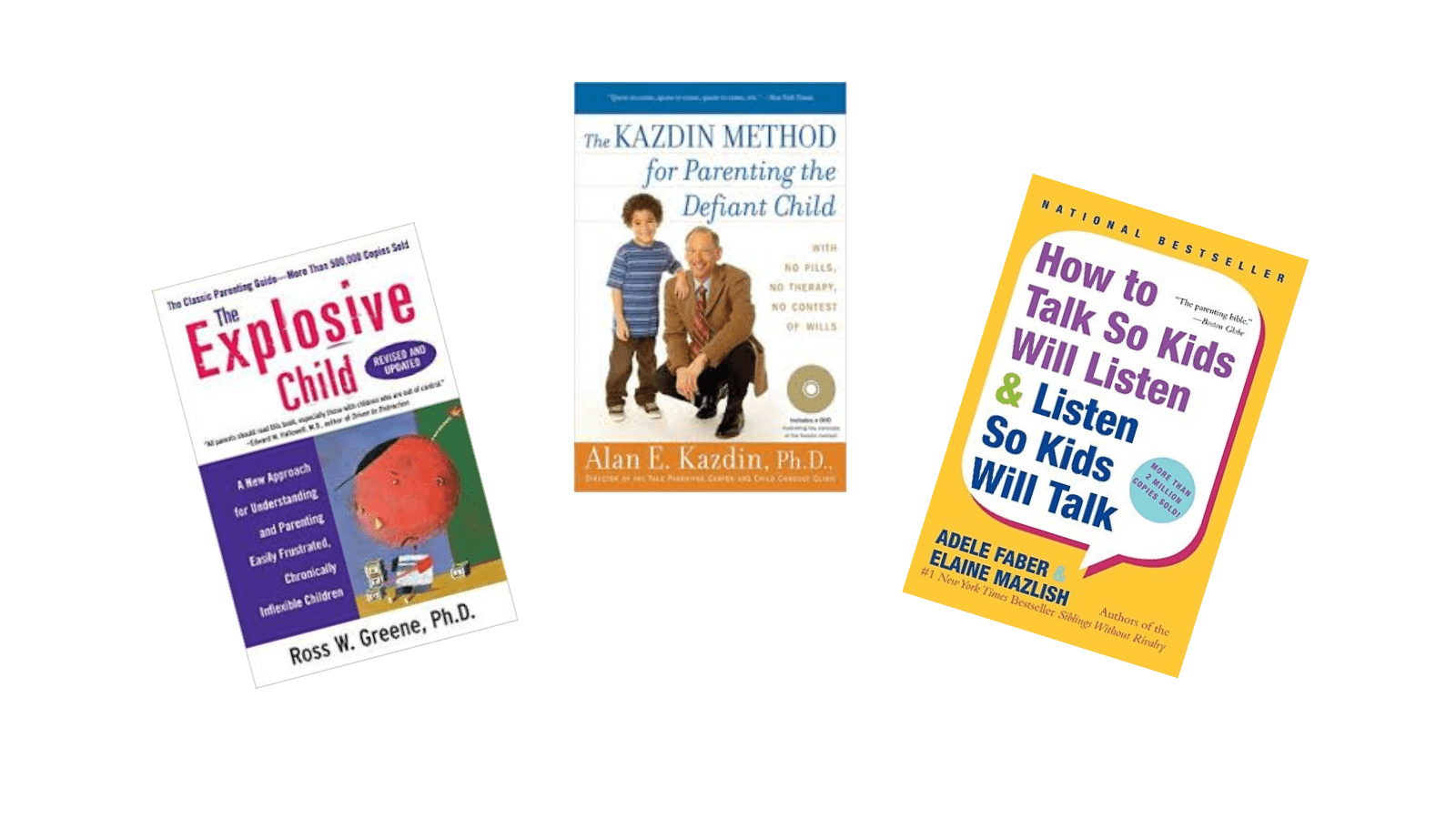
If you have a challenging child and are looking for parenting books, start with these three. Together they cover understanding why kids act out, building effective reward systems, and strengthening your relationship with your child — the three pillars of helping a challenging boy thrive.
I also want to add a plug for my own book: Challenging Boys: A Proven Plan for Keeping Your Cool and Helping Your Son Thrive. In it I have combined the wisdom from great parenting books like the three below — along with 30 years of experience working with challenging boys and their parents — into a step-by-step guide for building a customized plan to help your son thrive. You can download the introduction and first chapter free using the sign-up form at the end of this post.
The Explosive Child — Ross Greene
The Explosive Child: A New Approach for Understanding and Parenting Easily Frustrated, Chronically Inflexible Children is a fantastic book for understanding and working with the problems that create challenging behavior.
1. “Children do well if they can.”
When our kids misbehave, it can feel like willfulness, opposition, or defiance. It feels like they don’t want to do well. Ross Greene helps us see that our challenging kids actually do want to please us — but problems with frustration tolerance and inflexibility can make it so that they can’t do well even though they want to.
2. The best approach is to teach challenging kids the skills they need.
Punishments and rewards don’t help with most challenging behavior because they only affect motivation. Since challenging children are lacking the skills they need to cooperate consistently, no amount of motivational help will eliminate challenging behavior in the long run. Challenging children need to be taught the skills of frustration tolerance and flexibility.
3. Problem solving teaches challenging kids the skills they need to do well.
Greene emphasizes the power of problem solving to teach kids valuable life skills. Problem solving is not only a great way to solve individual problems, but it also actually helps kids develop the frustration tolerance and flexibility they need to succeed.
Children do well if they can. Our challenging kids want to please us — they just lack the skills to do so consistently.
The Kazdin Method for Parenting the Defiant Child — Alan Kazdin
You might be saying, “I’ve tried reward charts, and they don’t work.” This is a common experience because creating an effective reward chart isn’t as easy as it seems. Kazdin identifies the key ingredients that make reward charts work.
1. Determine a “positive opposite” behavior.
It’s much more effective to reward a child for doing a positive behavior than for not doing a negative one. Kazdin recommends building reward charts around reinforcing the positive behavior that is the opposite of what you want to eliminate. Rewarding the positive opposite automatically reduces the negative behavior.
2. Select appropriate rewards.
Kazdin recommends small rewards a child can earn quickly, plus a larger reward the child works toward over time. This combination is more effective than either alone. Rewards don’t need to be material — special activities or one-on-one time with a parent work great.
3. Break the desired behavior down into small pieces.
A good reward chart breaks the target behavior into smaller parts that can be separately rewarded, giving the child more opportunities for success and a new chance to succeed quickly after a failure. For example, rather than one point for getting ready for school on time, give points for getting up, getting dressed, brushing teeth — each by a specific time.
How to Talk So Kids Will Listen — Adele Faber & Elaine Mazlish
How to Talk So Kids Will Listen & Listen So Kids Will Talk picks up where The Explosive Child and The Kazdin Method leave off. It’s important to balance our efforts to manage challenging behavior with consistent work aimed at fostering a positive parent-child relationship — and this book shows exactly how to do that.
1. “There is a direct connection between how kids feel and how they behave.”
Bad feelings — anger, sadness, anxiety — are frequently the cause of a child’s “bad” behavior. Helping children cope with these difficult feelings is the best path to better behavior.
2. The best way to help kids feel good is to accept and respect their feelings.
When we listen to our child’s feelings with full attention and take his or her upset seriously — even when the situation seems small — we help our child develop the ability to accept and manage his or her own feelings. Today we recognize that this type of emotional intelligence is as important for success in life as IQ. Accepting and validating feelings does not mean we agree with them. It is soothing to anyone to have his or her feelings acknowledged sympathetically — for kids, it is essential. When we deny our children’s feelings it often leads to arguments, hostility, and poor cooperation.
3. Punishments should be abandoned in favor of problem solving.
Punishments get a child’s attention, but they actually divert our child’s attention away from reflecting on and taking responsibility for misbehavior — focusing the child on resentment toward us instead. Faber and Mazlish suggest that parents and children use problem solving to resolve the conflict or issue that lies behind misbehavior. The book is full of real-life examples that can be immediately applied at home.
Child psychologist with over 30 years of experience working with challenging boys and their families. Author of Challenging Boys: A Proven Plan for Keeping Your Cool and Helping Your Son Thrive (Rowman & Littlefield, 2025) and a former firefighter.
Get the tools to stay calm when it matters most.
Download the first chapter of Challenging Boys free