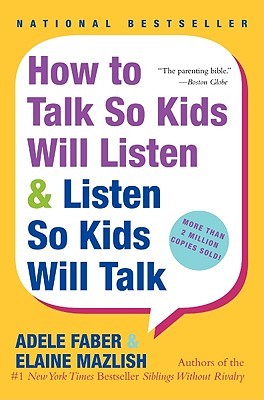
The Best Parenting Book: A Review of “How to Talk So Kids Will Listen.”
In my roles as a parent and as a psychologist, I’ve read many books on parenting. My favorite by far — I’ve read it four or five times — is Adele Faber and Elaine Mazlish’s How to Talk So Kids Will Listen & Listen So Kids Will Talk.
The book is based on the work of famed child psychologist Haim Ginott, presented in a far more accessible and immediately applicable format than Ginott’s own classic, Between Parent & Child.
The Core Idea: Feelings First
How to Talk So Kids Will Listen presents an approach that assumes a direct connection between how kids feel and how they behave. Instead of enforcing cooperation through threats, scoldings, bribes, or punishments, Faber and Mazlish believe that helping our children feel better is the most effective way to get them to behave better.
We do this by accepting and respecting their feelings. Denying our children’s feelings creates arguments, hostility, and poor cooperation. A major obstacle for most of us is that our own feelings weren’t accepted as children — so our parenting instincts frequently lead us to inadvertently deny our children’s feelings even when we’re genuinely trying to help.
What the Book Covers
The book is full of specific strategies illustrated by easy-to-follow examples across six chapters:
- Chapter 1: Helping Children Deal with Their Feelings
- Chapter 2: Engaging Cooperation
- Chapter 3: Alternatives to Punishment
- Chapter 4: Encouraging Autonomy
- Chapter 5: Praise
- Chapter 6: Freeing Children from Playing Roles
Faber and Mazlish believe that parents who demonstrate genuine acceptance and respect in their interactions with their children will raise confident, responsible, and emotionally intelligent people who know how to resolve differences effectively.
While the book does describe strategies for engaging cooperation without yelling or threats, it’s actually about much more than “getting kids to listen.” At its core, it presents an overall approach to parenting based on mutual respect — one I return to again and again in my own work with families.
Helping our children feel better is the most effective way to get them to behave better.
Child psychologist with over 30 years of experience working with challenging boys and their families. Author of Challenging Boys: A Proven Plan for Keeping Your Cool and Helping Your Son Thrive (Rowman & Littlefield, 2025) and a former firefighter.
Get the tools to stay calm when it matters most.
Download the first chapter of Challenging Boys free